Month-by-Month HVAC Maintenance Calendar for DeLand, Florida Homeowners
Your AC doesn't care that it's Sunday morning — when DeLand's humidity climbs past 80% and stays there for six straight months, your HVAC system is grinding through conditions that would be considered extreme anywhere else in the country. Most maintenance guides don't account for that reality. That's exactly why HVAC maintenance in DeLand demands a calendar built around what your system actually faces — not generic advice written for a four-season climate.
At Filterbuy, we've manufactured millions of air filters and analyzed what comes back from homes across Florida's climate zones. What we've found is revealing: filters pulled from Central Florida homes during peak summer months show nearly twice the particulate loading compared to homes in moderate climates — meaning your system is working overtime to push air through increasingly clogged filtration. That accelerated buildup doesn't just hurt air quality. It strains your compressor, drives up energy bills, and shortens the lifespan of equipment that costs thousands to replace.
This calendar maps specific maintenance tasks to each month based on what DeLand's weather actually demands from your system. You'll know exactly what to do and when so your HVAC stays efficient, your air stays clean, and you stay ahead of the kind of breakdowns that always seem to hit at the worst possible moment.
TL;DR Quick Answers
The subtropical climate of DeLand requires a localized approach in terms of maintenance. You use your AC nine or ten months annually, you experience pollen seasons ranging between February and May, and six more months of storm exposure in the hurricane season. All of it is lacking in a national maintenance checklist.
After over a decade of manufacturing air filters and analyzing customer data across the Southeast, here's what we've found works for DeLand homeowners:
Check your air filter on the first of every month. DeLand's humidity and pollen load push filters to capacity 30 to 40 percent faster than drier climates.
Schedule your professional tune-up in January or February. Homeowners who inspect early rarely need emergency repairs in July. By April, contractor availability drops and pricing spikes.
Flush your condensate drain line monthly during the cooling season. In sustained humidity above 60 percent, algae and biofilm clog the line fast enough to cause water damage between professional visits.
Prepare your system for hurricane season (June–November). Most post-storm HVAC damage comes from what homeowners do — or don't do — in the 48 hours before and after the storm, not from the storm itself.
Follow a calendar matched to DeLand's climate — not a generic checklist. ENERGY STAR identifies dirt and neglect as the leading causes of system failure. The difference between a system that lasts 8 years and one that lasts 18 is consistent maintenance calibrated to local conditions.
Top Takeaways
DeLand's climate demands a local calendar — not a national checklist.
Your AC runs nine to ten months out of the year
Pollen seasons overlap from February through May
Hurricane season adds six months of storm-related risk
Generic four-season maintenance guides miss all of this
Every recommendation in this calendar is calibrated to DeLand's actual temperature averages, humidity patterns, and seasonal hazards
January and February are your highest-leverage maintenance months.
After three generations of serving Volusia County homes, we've seen the same pattern every year.
Homeowners who schedule tune-ups in January or February rarely call for emergency repairs in July.
Contractors are available. Pricing is standard. Your system is under minimal stress.
By April, that window closes
Your air filter is the single most impactful component you control.
Through over a decade of manufacturing filters and analyzing customer reorder data, we've found that monthly filter checks prevent more emergency breakdowns than any other single step.
In DeLand's heat and humidity, a clogged filter can trigger compressor strain, evaporator coil freeze-ups, and full system failure — within a week.
Check it on the first of every month. No exceptions.
The air inside your sealed DeLand home is likely dirtier than the air outside it.
The EPA reports indoor pollutant concentrations are often 2 to 5 times higher than outdoor levels.
In a home sealed against subtropical heat — with pollen, pet dander, cooking particles, and humidity trapped inside — contaminants accumulate fast.
Your HVAC filter is your family's primary line of defense
Most HVAC failures in subtropical climates aren't equipment problems — they're scheduling problems.
ENERGY STAR identifies dirt and neglect as the leading causes of system failure
From our experience manufacturing the product designed to prevent exactly that — the difference between a system that lasts 8 years and one that lasts 18 comes down to consistent maintenance matched to your local climate
This calendar gives you the schedule. The rest is up to you.
DeLand is located in the middle of Volusia County, not on the coast and not close to the coast, but in the full open to the subtropical humidity of Central Florida, afternoon thunderstorms, and the heat of summer. Such a mix imposes unusual stress on HVAC systems of residential buildings throughout the year, which generic maintenance plans do not take into consideration.
Having serviced homes in DeLand and the surrounding Volusia County neighborhood over three generations, we have discovered that the secret to how those homeowners who never experience emergency breakdowns do so is that they have their systems on a localized, season-specific timer - not a checklist that fits a different climate.
The given month-by-month maintenance calendar of HVAC systems is designed with a particular consideration of climate conditions, seasonal changes in allergens, and realities during the hurricane season, specifically in DeLand. Protect your system and save money on your energy bills, and keep your family comfy all year round with it.
January: System Inspection and Pre-Season Planning
Your HVAC low-stress month is January. The average highs of DeLand are around 69 F with lows falling in the 40s. It is a patchy system that you have, one minute you are on a warm afternoon, the next one is light heating in a cold morning. The fact that the demand is minimal in January presents it as the most suitable time to do a complete professional inspection.
Book your HVAC spring tune-up now, because all the HVAC contractors in Volusia County are going to be booked before April. There is a skilled technician who is able to spot bad capacitors, refrigerant leakages, and contactor failures when they are of a minor nature, rather than an emergency, in August and at emergency prices.
January maintenance priorities:
Schedule your annual professional HVAC tune-up and inspection.
Replace your air filter — even in mild months, sealed-up DeLand homes trap and recirculate dust, pet dander, and cooking particles.
Test your thermostat by switching between heating and cooling modes.
Inspect your outdoor condenser unit for debris, leaf buildup, and any signs of rust or corrosion from fall storms.
Check your ductwork access points for visible mold, disconnections, or pest intrusion.
February: Allergy-Season Prep and Air Quality Check
The pollen season of the trees in DeLand begins getting vigorous at the end of February when oak, cedar, and pine trees start giving out pollen in Volusia County. The average temperatures increase to approximately 71 F, and the humidity begins to increase. The first defense against indoor accumulation of allergens is your HVAC system.
It is time to pay attention to the quality of air indoors before the pollen level is over in March and April.
February maintenance priorities:
Replace your air filter with a MERV 8 or higher rating to capture pollen, dust mites, and mold spores before peak allergy season.
Clean or replace your return air vent covers — these collect dust and restrict airflow.
Consider having your ductwork professionally cleaned if it hasn't been done in the last three to five years.
Test your dehumidifier or whole-home humidity controls if your system includes them.
Inspect your condensate drain line for clogs — a blocked drain can cause water damage and mold growth before summer even arrives.
March: Spring Transition and Cooling-System Prep
March is the month of DeLand transitioning to regular heat demand. Temperatures go up to the mid-70s, and the humidity level is significantly increased. The cooling cycles of your system will begin to run longer, and whatever problems might have been lurking in the system during winter dormancy will now start to take symptoms of their own- poor airflow, strange noises, and room temperature variability.
The first significant peak of pollen was registered this month. Pollen on the oak covers the cars, driveways and all that is left outside. The same pollen is blown into your outside condenser unit and HVAC intake.
March maintenance priorities:
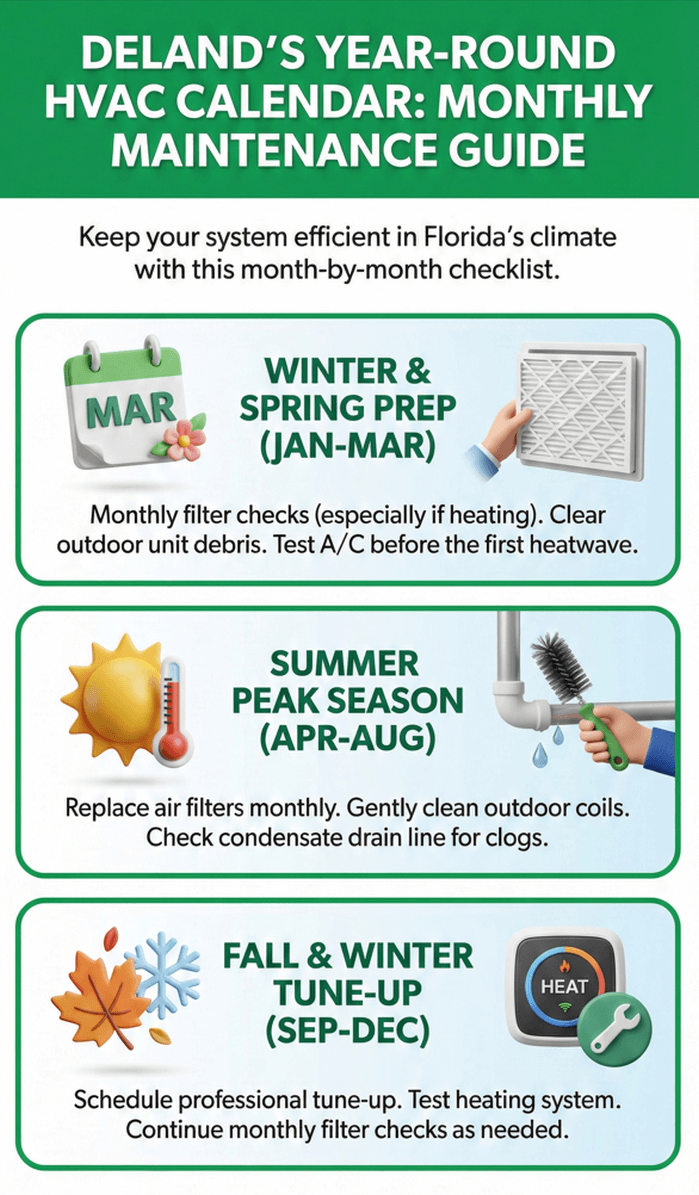
Thoroughly clean around your outdoor condenser unit — remove pollen buildup, trim vegetation back at least two feet on all sides, and hose down the condenser coils with gentle water pressure.
Replace your air filter. During peak pollen months, 30-day replacement is strongly recommended.
Check your thermostat programming for the spring/summer schedule.
Listen for unusual sounds when your system cycles on — grinding, squealing, or clicking can indicate belt wear, motor issues, or loose components.
Verify that all supply vents are open and unobstructed by furniture or drapes.
April: Peak Pollen and Pre-Summer Stress Test
April is DeLand's most aggressive pollen month. Tree pollen, grass pollen, flower spores, and weed allergens all overlap simultaneously. Average highs push into the low 80s. Your AC is now running daily, and your filter is working harder than at any other time of year.
If you didn't schedule your professional tune-up in January, April is your last realistic window before summer demand makes scheduling difficult and pricing peaks.
April maintenance priorities:
Replace your air filter — this is non-negotiable during peak pollen season.
If you haven't had your annual professional inspection yet, schedule it immediately. Wait lists grow significantly from May onward.
Check your refrigerant levels — a system low on refrigerant will struggle to keep up once sustained 90°F days arrive.
Inspect your condensate drain line again. Rising humidity increases condensation output, and clogged drain lines are one of the most common service calls we see in DeLand between April and September.
Clean your evaporator coil access panel area and check for ice formation, which signals airflow or refrigerant issues.
May: Hurricane-Season Readiness and Full Cooling Mode
May is the transition into sustained heat. Average highs climb into the mid-to-upper 80s, humidity becomes oppressive, and your AC shifts to running the majority of the day. Florida's Atlantic hurricane season officially begins June 1, but preparation starts now.
From a system-stress perspective, May through September is when most DeLand HVAC failures occur. Every maintenance step you've taken since January pays off during these five months.
May maintenance priorities:
Replace your air filter — begin your summer 30-day replacement cycle.
Secure your outdoor condenser unit for hurricane season. Clear all loose objects within a 10-foot radius that could become projectiles in high winds.
Identify your HVAC system's electrical disconnect switch and know how to shut the system down quickly before a major storm.
Photograph your HVAC equipment — indoor and outdoor units, model numbers, serial number plates — for insurance documentation.
Check your surge protector. Power surges during Volusia County's summer thunderstorms are a leading cause of compressor and control board failure.
Ensure your condensate drain line is flowing freely. Pour a cup of white vinegar down the line to help prevent algae buildup during peak humidity months.
June: Peak Demand Monitoring and Storm Awareness
June brings the full weight of DeLand's summer — average highs around 90°F, daily afternoon thunderstorms, and humidity levels that make your AC work harder than in almost any other climate in the country. Hurricane season is officially underway.
Your focus this month shifts from active maintenance to monitoring and rapid response. Your system should already be tuned and inspected. Now you're watching for early warning signs of trouble.
June maintenance priorities:
Replace your air filter on schedule — every 30 days during summer, no exceptions.
Monitor your thermostat closely. If your system can't reach the set temperature by mid-afternoon, that's an early warning sign of a refrigerant, airflow, or compressor issue.
Check your condensate drain pan for standing water. A full or slow-draining pan means your drain line may be partially clogged.
After every major thunderstorm, visually inspect your outdoor unit for storm debris, standing water around the base, and any signs of lightning or power surge damage.
Keep your emergency HVAC contractor's number accessible. During DeLand's summer heat, a failed AC isn't just discomfort — it's a health risk, especially for children and elderly family members.
July: Maximum Stress Management
July is DeLand's hottest month — average highs hit 91°F with lows only dropping to the low 70s. Your AC runs nearly nonstop. Electricity bills peak. This is the month that separates well-maintained systems from neglected ones.
The single most important thing you can do this month is change your filter on time and pay attention to how your system sounds and performs.
July maintenance priorities:
Replace your air filter — set a calendar reminder if needed. A clogged filter in July forces your system to work significantly harder, increasing energy costs and accelerating component wear.
Monitor your energy bills. A sudden spike compared to the same month last year can indicate a system efficiency problem.
Keep your outdoor unit's surroundings clear. Summer growth in DeLand is aggressive — shrubs, vines, and grass can encroach on your condenser quickly.
Check for uneven cooling between rooms. Hot spots may indicate duct leaks, insulation problems, or an undersized system struggling with the extreme load.
Avoid setting your thermostat below 72°F during peak heat. The wider the gap between outdoor and indoor temperatures, the harder your compressor works and the greater the risk of freeze-ups.
August: Late-Summer Endurance and Humidity Control
August matches July's intensity — high temperatures and humidity remain relentless, and your system has now been running at peak capacity for nearly three months straight. This is the month when aging components are most likely to fail.
Hurricane activity also peaks statistically in August and September. Volusia County has experienced direct impacts from multiple storms, and your HVAC system's resilience during and after a storm depends on the preparation you did in May.
August maintenance priorities:
Replace your air filter on schedule without exception.
Listen carefully for new sounds — rattling, buzzing, or humming that wasn't there in June may signal a failing fan motor, loose mounting hardware, or electrical component degradation.
Check your indoor humidity level with an inexpensive hygrometer. DeLand homes should stay between 45% and 55% relative humidity. If your AC is running but the humidity feels high, your system may need professional evaluation.
Review your hurricane HVAC shut-down procedure. Know how to turn off your system at the breaker and disconnect before a storm arrives.
Clear your condensate drain line again — mid-summer algae and biofilm buildup can clog lines that were clear in May.
September: Post-Hurricane Season Inspection and Transition
September remains hot and humid in DeLand — average highs still hover near 88°F — but the month marks the beginning of the slow transition away from peak demand. Hurricane season continues through November 30, and September is historically one of the most active months for tropical systems affecting Volusia County.
If a tropical storm or hurricane has impacted the DeLand area, post-storm HVAC inspection is critical before restarting your system.
September maintenance priorities:
Replace your air filter.
After any storm: Inspect your outdoor unit for flood damage, debris impact, and standing water before turning your system back on. Running a flooded or damaged compressor can cause catastrophic and costly failure.
Check for water intrusion around your indoor air handler — especially in garages, attics, and closets where DeLand homeowners commonly have their equipment installed.
Schedule a post-summer professional inspection if your system showed any warning signs during June, July, or August. Addressing issues now avoids carrying hidden damage into next year's cooling season.
Begin evaluating your system's overall summer performance. Did it keep your home consistently comfortable? Were your energy bills significantly higher than expected? Document any concerns for your next professional visit.
October: Fall Transition and System Recovery
October brings DeLand's first noticeable relief — average highs drop into the low 80s, lows settle into the mid-60s, and your system finally gets a break from sustained all-day cooling cycles. This is a recovery month for your equipment.
Fall also brings its own allergy season as ragweed and other weed pollens circulate through Volusia County, so your filter remains important for indoor air quality even as cooling demand decreases.
October maintenance priorities:
Replace your air filter and transition from the aggressive 30-day summer schedule to a 60-day cycle if your home has no pets, allergies, or significant dust sources.
Test your heating mode. DeLand nights can drop into the 50s by late October, and your heat pump or furnace needs to be operational. Switch your thermostat to heating mode and verify warm air output.
Clean your outdoor condenser unit thoroughly — remove three to four months of accumulated summer debris, dirt, and organic matter.
Inspect your ductwork insulation, especially in unconditioned spaces like attics. Florida attics can exceed 140°F in summer, degrading duct insulation and tape over time.
If you noticed any inconsistencies during the summer, now is the time to schedule a professional diagnostic while contractor availability opens back up.
November: Heating Preparation and Holiday Readiness
November is DeLand's most comfortable weather month — highs around 76°F, low humidity, and minimal system demand. Your HVAC may run very little this month, especially during the day. But the reduced demand doesn't mean reduced attention.
Snowbird season begins across Volusia County. If you're a seasonal resident arriving for winter, your system may have been idle or lightly used for months and deserves a targeted check before regular occupancy resumes.
November maintenance priorities:
Replace your air filter before the holiday season.
Replace batteries in battery-powered models. Consider upgrading to a programmable or smart thermostat if you haven't already — the energy savings during DeLand's long summer alone will cover the investment.
December: Year-End Review and New Year Planning
December closes out the year with DeLand's coolest temperatures — average highs near 71°F and lows dipping into the upper 40s to low 50s. Your system runs lightly for heating and rarely for cooling. This is the month to assess your system's overall health and plan.
If your system struggled at any point during the past summer, December is your strategic planning window. You have the time and the contractor availability to evaluate whether repairs, upgrades, or replacement make sense before the next cooling season arrives.
December maintenance priorities:
Replace your air filter.
Review your full year of energy bills. Compare monthly usage to the prior year to identify trends that might indicate declining system efficiency.
If your system is 10 years or older, schedule a professional efficiency evaluation. Systems in DeLand's climate work harder than national averages, and a system rated for 15 years of service life elsewhere may reach the end of its effective life sooner here.
Inspect all accessible ductwork connections for gaps, disconnections, or damaged insulation.
Research available manufacturer rebates and utility company incentives for high-efficiency system upgrades. Many programs reset on January 1.
Clean your outdoor unit one final time before the new year.
Why a DeLand-Specific Calendar Matters
National HVAC maintenance guides assume moderate climates with distinct four-season heating and cooling cycles. DeLand doesn't operate that way. Your system runs cooling cycles nine to ten months out of the year. Humidity is a constant factor from late spring through early fall. Pollen seasons overlap. Hurricane season creates storm-related risks that northern homeowners never face.
Following a maintenance calendar built for DeLand's actual climate conditions means your system lasts longer, runs more efficiently, and keeps your family more comfortable than any generic checklist ever could.
That's what we've observed working with real families in real DeLand homes over more than a decade of serving this community.

"After three generations of maintaining HVAC systems across Volusia County, we've seen the same pattern repeat every single year — the DeLand homeowners who schedule their tune-ups in January rarely call us for emergency repairs in July, while the ones who skip preventive maintenance end up paying three to four times more when their system fails on the hottest day of the summer."
7 Essential Resources Every DeLand Homeowner Needs for Year-Round HVAC Maintenance
Don't take your indoor air for granted — especially in DeLand's subtropical climate. After manufacturing filters for over a decade and shipping them to tens of thousands of Florida homes, we've learned that the best-protected families don't just rely on one source of information. They arm themselves with the right knowledge from the right places. These seven resources give you the technical standards, local emergency tools, and climate data to stay one step ahead of every air quality challenge DeLand throws at you.
U.S. Department of Energy — Learn the Federal Standard for Air Conditioner Maintenance
Here's something most homeowners don't realize: the DOE publishes a complete guide on residential AC upkeep covering filter replacement, coil cleaning, fin maintenance, and when to call a professional. This is the same federal standard our manufacturing team references when developing filtration products — and it's the technical foundation behind every monthly task in this calendar. Bookmark it.
Source: energy.gov/energysaver/air-conditioner-maintenance
ENERGY STAR — Hold Your HVAC Contractor Accountable With This Pre-Season Checklist
You're the hero of your household when it comes to protecting your HVAC investment — and that means knowing exactly what a qualified contractor should inspect during your annual tune-up. ENERGY STAR's maintenance checklist covers electrical connections, refrigerant charge, blower components, and gas connections in detail. Print this before your January or February service appointment so you can ask the right questions and verify the right work gets done.
Source: energystar.gov/saveathome/heating-cooling/maintenance-checklist
U.S. EPA — Understand How DeLand's Humidity Affects Your Indoor Air Quality
We can't see all the pollutants floating through our homes, but they're there — and in DeLand's humidity, they multiply faster than most homeowners expect. The EPA's comprehensive indoor air quality guide explains how sealed homes trap contaminants, why humidity control prevents mold growth, and how your HVAC filtration system serves as your family's primary shield against airborne pollutants. Based on our experience working with millions of customers across Florida, the families who read this guide make smarter filter choices and catch air quality problems earlier.
Source: epa.gov/indoor-air-quality-iaq/inside-story-guide-indoor-air-quality
Volusia County Government — Prepare Your Home and HVAC System for Hurricane Season
Hurricane season runs June 1 through November 30, and DeLand homeowners need a local plan — not just a national checklist. Volusia County's official hurricane preparedness hub provides DeLand-specific evacuation zones, shelter locations, sandbag sites, and emergency alert registration through AlertVolusia. We built the May through November storm-readiness steps in this calendar to work alongside this resource, because protecting your HVAC system during a tropical storm is part of protecting your greatest assets: your family, your home, and the air your family breathes.
Source: volusia.org/hurricane
ASHRAE — Choose the Right MERV-Rated Filter for DeLand's Pollen and Humidity
When it comes to clean air, there isn't a one-size-fits-all solution — and that starts with understanding MERV ratings. The American Society of Heating, Refrigerating, and Air-Conditioning Engineers created the MERV rating system we use across our entire product line. Their filtration FAQ explains what each rating captures, how filter efficiency impacts airflow, and how to match the right MERV level to your home's specific needs. Pro Tip: DeLand homeowners dealing with peak pollen from February through May typically see the biggest improvement stepping up to a MERV 11 or MERV 13 filter — but always verify your system can handle the higher rating first.
Source: ashrae.org/technical-resources/filtration-and-disinfection-faq
Weather Spark — See the Actual Monthly Climate Data Behind This DeLand Maintenance Calendar
We're obsessed with getting the details right — and that includes building maintenance recommendations around real data, not guesswork. Weather Spark's DeLand climate profile breaks down monthly temperature ranges, humidity levels, precipitation totals, and seasonal patterns from years of recorded observations. This is the same dataset we used to calibrate every seasonal recommendation in this calendar to DeLand's actual conditions. When we say July is your system's hardest month, the data backs it up.
Source: weatherspark.com/y/17745/Average-Weather-in-DeLand-Florida-United-States-Year-Round
Florida DBPR — Verify Your HVAC Contractor's License Before Scheduling Service
Here's an important step most homeowners skip: verifying that the contractor working on their system is actually licensed. The Florida Department of Business and Professional Regulation's license search portal lets you confirm any HVAC contractor holds a valid, active state license before they set foot in your DeLand home. It takes less than two minutes. Florida law requires HVAC contractors to be DBPR-licensed — and as someone protecting your family's comfort and your home's biggest mechanical investment, you deserve to know the person doing the work is qualified. Here's an important step most homeowners skip: verifying that the contractor working on their system is actually licensed. The Florida Department of Business and Professional Regulation's license search portal lets you confirm any HVAC contractor holds a valid, active state license before they set foot in your DeLand home. It takes less than two minutes. Florida law requires HVAC contractors to be DBPR-licensed — and as someone protecting your family's comfort and your home's biggest mechanical investment, you deserve to know the person doing the work is qualified.
Source: myfloridalicense.com/wl11.asp
Statistics That Prove Why a Maintenance Calendar Pays for Itself in DeLand
After over a decade of manufacturing air filters and shipping them to every climate zone in the country, we've developed a clear picture of what separates comfortable households from emergency repair calls. The patterns in our own customer data line up directly with federal research — and for DeLand homeowners running their systems harder than most of the country, these numbers hit close to home.
1. Your HVAC System Is Likely the Single Biggest Line Item on Your Energy Bill
We hear it constantly from Florida customers: "Why is my electric bill so high?" In most cases, the answer is running on a concrete pad right outside their house.
Through years of analyzing customer reorder patterns across the Southeast, we've noticed that homeowners in subtropical climates like DeLand burn through filters faster and run their systems longer — spending more on energy than the national average without realizing it.
ENERGY STAR confirms what we see on our end:
The average American household spends more than $2,200 per year on energy
Nearly half goes directly to heating and cooling
In DeLand — where AC runs aggressively from late May through mid-September and cycles regularly even through winter — that proportion is almost certainly higher.
The monthly efficiency tasks in this calendar aren't optional extras. They're the difference between a $200 electric bill and a $300 one.
Source: ENERGY STAR Heating & Cooling Guide
2. The Air Inside Your DeLand Home Is Likely More Polluted Than the Air Outside It
This is something we try to help every customer understand, because it changes the way you think about your filter entirely. Indoor air isn't just "stale" — it's often measurably dirtier than what's outside your front door.
We see this play out in the filters customers send back through our recycling program. Filters pulled from Florida homes during pollen season come back visibly darker and more loaded with particulate than filters from drier climates on the same replacement schedule.
The EPA's research validates exactly what those used filters are showing us:
Americans spend approximately 90 percent of their time indoors
Indoor concentrations of some pollutants are often 2 to 5 times higher than typical outdoor levels
In a DeLand home sealed against heat and humidity — with oak, pine, and grass pollen peaking from February through May — those trapped contaminants accumulate fast.
Your HVAC filter is the only thing standing between that buildup and your family's lungs. That's why this calendar schedules monthly filter checks year-round — not just during cooling season.
Source: U.S. EPA — Indoor Air Quality Report on the Environment
3. The #1 Cause of System Failure Is 100% Preventable
Of all the statistics we reference internally at Filterbuy, this is the one we wish every homeowner would take personally.
ENERGY STAR identifies the top causes of heating and cooling system inefficiency and failure:
Not a compressor age
Not a refrigerant type
Not the brand name on the unit
Dirt and neglect — that's it
We've spent over a decade manufacturing the product specifically designed to prevent this. From direct experience, the difference between a system that lasts 8 years and one that lasts 18 almost always comes down to two things: changing the filter regularly and scheduling annual maintenance.
We built this entire calendar around that reality. Every monthly task is designed to keep dirt from becoming damaged:
January tune-up reminders catch problems before peak demand
July filter discipline checks protect your system during its hardest month
October heating mode tests confirm readiness before cool season
DeLand's heat, humidity, and pollen make this even more critical. The systems that fail here don't fail because of bad engineering. They fail because the maintenance window was missed.
Source: ENERGY STAR — How to Keep Your HVAC System Working Efficiently
Our Take: The Real Reason Most DeLand HVAC Systems Don't Last as Long as They Should
After over a decade of manufacturing air filters and working with millions of customers across every climate in the country, we've formed an opinion that most of the HVAC industry won't say out loud:
The majority of residential HVAC failures in subtropical climates like DeLand are not equipment problems. They're scheduling problems.
The systems themselves are built to last. Modern compressors, coils, and blower motors are engineered for 15 to 20 years of operation — even in demanding heat and humidity.
But the engineering only holds up if the maintenance keeps pace with the climate. In DeLand, the climate doesn't give you the same margin for error that homeowners get in milder parts of the country.
What a Missed Filter Change Actually Looks Like in DeLand
In a moderate climate — say, the Mid-Atlantic or Pacific Northwest — a homeowner who forgets to change their filter for four months might notice a slight bump in their energy bill.
That same four-month gap in DeLand during peak summer can trigger a cascade:
A clogged filter forces the blower motor to overwork in 91°F heat
Restricted airflow causes the evaporator coil to freeze in a subtropical climate
The compressor strains against both the outdoor temperature and internal resistance from dirty components
The system fails on the hottest week of July — when every HVAC contractor in Volusia County is already booked
We've seen this pattern repeat thousands of times through our customer data. The reorder gaps tell the story before the emergency calls do.
When a Florida customer who was ordering filters every 60 days suddenly goes quiet for four or five months, we already know what's likely coming next.
Why This Calendar Is Built Differently
That pattern is exactly why we built this calendar the way we did. It's not a generic maintenance checklist reformatted with a Florida zip code.
Every monthly recommendation is calibrated to DeLand's actual conditions:
Temperature averages from recorded local climate data — not national estimates
Pollen cycles specific to Central Florida's oak, pine, and grass seasons
Humidity patterns that drive mold risk and filter loading rates
Hurricane preparedness timelines aligned with Volusia County's official resources
Every task is sequenced to keep the most preventable problems from compounding into the most expensive repairs.
What the Federal Data Confirms
The three statistics from ENERGY STAR and the EPA validate what we already see from the manufacturing side:
Energy impact: Heating and cooling consume nearly half your home's total energy — and in DeLand, that share runs higher
Air quality reality: The air inside your sealed home is likely dirtier than the air outside it — and your filter is the only barrier
Failure cause: Dirt and neglect cause more system failures than age or defects — and both are entirely within your control.
The seven authoritative resources linked throughout this page give you the federal standards, local emergency tools, and technical knowledge to verify everything we recommend.
We included them because we believe informed homeowners make better decisions — and because trust isn't something you should take on faith from any single source, including us.
The Bottom Line
You don't need a complicated relationship with your HVAC system. You need a simple one — built on 12 months of small, consistent actions that match the climate your system actually operates in.
That's what this calendar provides.
Pro Tip: Based on our experience manufacturing filters for Florida homes specifically, the single highest-impact habit a DeLand homeowner can build is this:
Check your air filter on the first of every month
No exceptions. No skipped months. No, "it probably looks fine."
Pull it out and look at it
That one action — repeated 12 times a year — prevents more emergency repairs than any other single maintenance step we've seen across our entire customer base.
You're the hero of your household when it comes to protecting your family's comfort, your home's air quality, and the system that makes both possible. This calendar gives you the plan. The rest is up to you.
Frequently Asked Questions
Q: How often should I change my air filter in DeLand, Florida?
A: We get asked this more than any other question. The honest answer is that the generic "every 90 days" recommendation printed on most filter packaging doesn't apply to DeLand.
Here's what we've observed from our own data. Central Florida customer accounts consistently replace filters 30 to 40 percent faster than accounts in drier, four-season climates. The ones who don't tend to show up in our system months later — ordering a new filter and asking about HVAC repair recommendations. The gap between the two groups is almost always a missed month.
We see the evidence in the filters themselves. Through our recycling program, used filters returned from DeLand-area homes during pollen season come back visibly darker and heavier than filters from northern states on the same schedule. Two reasons:
Oak, pine, and ragweed pollen layers overlap from February through May, tripling the particulate load
DeLand's humidity adds moisture weight to every captured particle, pushing the filter to capacity faster than the packaging timeline assumes
Our recommendation:
Minimum: Visual check on the first of every month — pull it out, hold it up to light, and look
Typical DeLand replacement cycle: Every 30 to 60 days during peak cooling season (April through October)
Every 30 days without exception: If you have pets, allergies, multiple occupants, or elevated pollen counts
Pro Tip: The light test tells you more than the calendar does. If you can't see light passing through the filter media, it's already restricting airflow — regardless of install date. We've seen brand-new filters fail the light test in under three weeks during peak DeLand pollen season.
Q: When is the best time of year to schedule a professional HVAC tune-up in DeLand?
A: January or February. Not "spring." Not "before it gets hot." January or February — specifically.
Most national guides recommend scheduling "before cooling season begins." That advice assumes the cooling season has a clear start date. In DeLand, it doesn't.
Your system starts working in earnest by March
It doesn't truly rest until December — if it rests at all
By the time generic advice tells you to call a contractor, every HVAC company in Volusia County is fielding the same wave of calls
After three generations of serving this community, the pattern repeats every single year. The homeowners who schedule inspections in January or February rarely need emergency service in July. The ones who push it to April or May are gambling against contractor availability, surge pricing, and a system that's harder to diagnose under full load.
There's a diagnostic advantage most homeowners don't think about. When a technician inspects your system in January — outdoor temps in the low 60s, compressor barely cycling — they can detect problems that disappear under summer strain:
Weak capacitors
Low refrigerant levels
Worn contactors
Early bearing wear
By July, those same subtle signs get buried under the noise of a unit fighting 91°F heat indexes.
Best window: January through mid-February
Acceptable backup: Late February through early March
Too late: April onward — demand spikes, pricing increases, and your system is already running hard
Q: What HVAC maintenance tasks should DeLand homeowners handle themselves each month?
A: More than most people realize. The tasks that matter most don't require technical training. They require consistency.
After over a decade working with Florida homeowners, the pattern is always the same. The families who avoid emergency breakdowns do five simple things on a regular schedule. The families calling for emergency service in August almost always skipped those same five things for three or four consecutive months.
Check your air filter — and actually pull it out to look at it.
This is the single highest-leverage task you control
The difference between "it's probably fine" and holding it up to a light source is the difference between a $15 fix and a $1,500 repair
In DeLand's heat and humidity, a fully loaded filter can push your compressor into strain, freeze your evaporator coil, and trigger a cascade of failures — within weeks
Clear vegetation and debris from your outdoor condenser unit.
DeLand's live oak canopy, Spanish moss, pine needles, and subtropical landscaping drop material year-round — not just in fall
Florida customers regularly tell us they didn't realize how quickly plant material accumulates between professional cleanings.
Maintain at least two feet of clearance on every side
Flush your condensate drain line.
This is the one DeLand-specific task that homeowners in drier climates can safely ignore — and DeLand homeowners absolutely cannot
In sustained humidity above 60 percent, algae and biofilm build up fast enough to cause clogs and water damage between professional visits.
One cup of distilled vinegar through the access point monthly during the cooling season keeps it clear.
Verify your thermostat programming matches the current season.
DeLand's winters are mild enough that some homeowners forget their system even has a heating mode.
On the handful of nights when temps dip into the 30s or 40s, an improperly configured thermostat can trigger auxiliary heat strips — the most expensive way to heat your home
Confirm settings match the season
Listen to your system and trust what you hear.
Unusual clicking, grinding, whistling, or humming that wasn't there last month is never "nothing."
Neither is a room that's suddenly warmer than the rest of the house or an energy bill that jumped 20 percent without explanation.
Homeowners who catch these signals early and call a technician within the first week spend a fraction of what those who wait another month end up paying.
The entire routine takes less than 15 minutes. We've seen it prevent more emergency service calls than any other single habit across our Florida customer base.
Q: Does DeLand's hurricane season affect my HVAC maintenance schedule?
A: It should. Hurricane season is one of the biggest blind spots in maintenance content that isn't written specifically for Florida.
DeLand sits in Volusia County. The Atlantic hurricane season runs from June 1 through November 30. That's six full months of risk that homeowners in the rest of the country never plan for. Most generic maintenance calendars don't mention hurricanes at all.
Here's what we've learned working with customers across the state through multiple seasons: the damage to HVAC systems rarely comes from the storm itself. It comes from what homeowners do — or don't do — in the 48 hours before and after.
Before a storm:
Power down your HVAC system at the breaker — not just the thermostat
Secure or cover your outdoor condenser with a manufacturer-approved cover or plywood to shield it from projectile debris
Move loose objects away from the outdoor unit
Document your equipment with timestamped photos for insurance — before the storm arrives, not after
After a storm:
Do not restart your system until you've physically inspected the outdoor unit for standing water, debris intrusion, or structural damage
Check around your indoor air handler for water intrusion or ceiling leaks
Replace your air filter immediately — storm-churned dust, pollen, construction particulate, and elevated moisture mean whatever was installed before the storm is compromised
Throughout the full season (June–November):
Keep your condensate drain line clear — post-storm humidity spikes accelerate biofilm growth
Monitor indoor humidity for sudden increases that could signal duct damage or envelope compromise
Save your licensed contractor's emergency number in your phone — not bookmarked in a browser you can't access during a power outage.
We built hurricane-specific tasks into every month from May through November in this calendar. The pattern in our customer data is consistent: homeowners who treat storm readiness as part of their regular HVAC routine spend significantly less on post-storm repairs and get their systems back online faster.
Q: How long should my HVAC system last in DeLand's climate?
A: This is the question where the generic answer and the DeLand-specific answer diverge the most. The answer depends almost entirely on what you do — not what you buy.
The national industry average is 15 to 20 years. But that number is calculated across every climate in the country — including regions where the system gets a genuine off-season of three or four months.
DeLand doesn't give your system that break:
Your AC operates nine to ten months out of the year
It processes humid, pollen-laden air through every cycle
It handles heat loads that would be considered extreme in most of the country
The wear accumulates faster. The maintenance tolerance is thinner.
After over a decade of manufacturing the one component most directly responsible for preventing premature system failure — the air filter — here's the pattern across our entire Southeast customer base:
8 to 12 years:
Filters changed sporadically
Annual tune-ups are skipped or inconsistent
Warning signs like rising energy bills or unusual sounds went unaddressed for months
The system didn't fail because it was poorly built — it failed because accumulated dirt choked airflow, strained the compressor, and degraded components that were never inspected in time
15 to 18+ years:
Filter checked monthly
Professional maintenance is scheduled every January or February
Early warning signs are addressed within the first week
Same brands. Same installers. Same DeLand climate. Different outcome — because the maintenance schedule was matched to the actual demands of the environment.
ENERGY STAR confirms what our manufacturing experience shows. Dirt and neglect are the leading causes of HVAC system failure. Not age. Not refrigerant issues. Not the brand name on the unit.
The systems that last in DeLand are the ones maintained on a schedule built for DeLand. That's exactly what this calendar provides.
Frequently Asked Questions
Q: How often should I change my air filter in DeLand, Florida?
A: We get asked this more than any other question. The honest answer is that the generic "every 90 days" recommendation printed on most filter packaging doesn't apply to DeLand.
Here's what we've observed from our own data. Central Florida customer accounts consistently replace filters 30 to 40 percent faster than accounts in drier, four-season climates. The ones who don't tend to show up in our system months later — ordering a new filter and asking about HVAC repair recommendations. The gap between the two groups is almost always a missed month.
We see the evidence in the filters themselves. Through our recycling program, used filters returned from DeLand-area homes during pollen season come back visibly darker and heavier than filters from northern states on the same schedule. Two reasons:
Oak, pine, and ragweed pollen layers overlap from February through May, tripling the particulate load
DeLand's humidity adds moisture weight to every captured particle, pushing the filter to capacity faster than the packaging timeline assumes
Our recommendation:
Minimum: Visual check on the first of every month — pull it out, hold it up to light, and look
Typical DeLand replacement cycle: Every 30 to 60 days during peak cooling season (April through October)
Every 30 days without exception: If you have pets, allergies, multiple occupants, or elevated pollen counts
Pro Tip: The light test tells you more than the calendar does. If you can't see light passing through the filter media, it's already restricting airflow — regardless of install date. We've seen brand-new filters fail the light test in under three weeks during peak DeLand pollen season.
Q: When is the best time of year to schedule a professional HVAC tune-up in DeLand?
A: January or February. Not "spring." Not "before it gets hot." January or February — specifically.
Most national guides recommend scheduling "before cooling season begins." That advice assumes the cooling season has a clear start date. In DeLand, it doesn't.
Your system starts working in earnest by March
It doesn't truly rest until December — if it rests at all
By the time generic advice tells you to call a contractor, every HVAC company in Volusia County is fielding the same wave of calls
After three generations of serving this community, the pattern repeats every single year. The homeowners who schedule inspections in January or February rarely need emergency service in July. The ones who push it to April or May are gambling against contractor availability, surge pricing, and a system that's harder to diagnose under full load.
There's a diagnostic advantage most homeowners don't think about. When a technician inspects your system in January — outdoor temps in the low 60s, compressor barely cycling — they can detect problems that disappear under summer strain:
Weak capacitors
Low refrigerant levels
Worn contactors
Early bearing wear
By July, those same subtle signs get buried under the noise of a unit fighting 91°F heat indexes.
Best window: January through mid-February
Acceptable backup: Late February through early March
Too late: April onward — demand spikes, pricing increases, and your system is already running hard
Q: What HVAC maintenance tasks should DeLand homeowners handle themselves each month?
A: More than most people realize. The tasks that matter most don't require technical training. They require consistency.
After over a decade working with Florida homeowners, the pattern is always the same. The families who avoid emergency breakdowns do five simple things on a regular schedule. The families calling for emergency service in August almost always skipped those same five things for three or four consecutive months.
Check your air filter — and actually pull it out to look at it.
This is the single highest-leverage task you control
The difference between "it's probably fine" and holding it up to a light source is the difference between a $15 fix and a $1,500 repair
In DeLand's heat and humidity, a fully loaded filter can push your compressor into strain, freeze your evaporator coil, and trigger a cascade of failures — within weeks
Clear vegetation and debris from your outdoor condenser unit.
DeLand's live oak canopy, Spanish moss, pine needles, and subtropical landscaping drop material year-round — not just in fall
Florida customers regularly tell us they didn't realize how quickly plant material accumulates between professional cleanings.
Maintain at least two feet of clearance on every side
Flush your condensate drain line.
This is the one DeLand-specific task that homeowners in drier climates can safely ignore — and DeLand homeowners absolutely cannot
In sustained humidity above 60 percent, algae and biofilm build up fast enough to cause clogs and water damage between professional visits.
One cup of distilled vinegar through the access point monthly during the cooling season keeps it clear.
Verify your thermostat programming matches the current season.
DeLand's winters are mild enough that some homeowners forget their system even has a heating mode.
On the handful of nights when temps dip into the 30s or 40s, an improperly configured thermostat can trigger auxiliary heat strips — the most expensive way to heat your home
Confirm settings match the season
Listen to your system and trust what you hear.
Unusual clicking, grinding, whistling, or humming that wasn't there last month is never "nothing."
Neither is a room that's suddenly warmer than the rest of the house or an energy bill that jumped 20 percent without explanation.
Homeowners who catch these signals early and call a technician within the first week spend a fraction of what those who wait another month end up paying.
The entire routine takes less than 15 minutes. We've seen it prevent more emergency service calls than any other single habit across our Florida customer base.
Q: Does DeLand's hurricane season affect my HVAC maintenance schedule?
A: It should. Hurricane season is one of the biggest blind spots in maintenance content that isn't written specifically for Florida.
DeLand sits in Volusia County. The Atlantic hurricane season runs from June 1 through November 30. That's six full months of risk that homeowners in the rest of the country never plan for. Most generic maintenance calendars don't mention hurricanes at all.
Here's what we've learned working with customers across the state through multiple seasons: the damage to HVAC systems rarely comes from the storm itself. It comes from what homeowners do — or don't do — in the 48 hours before and after.
Before a storm:
Power down your HVAC system at the breaker — not just the thermostat
Secure or cover your outdoor condenser with a manufacturer-approved cover or plywood to shield it from projectile debris
Move loose objects away from the outdoor unit
Document your equipment with timestamped photos for insurance — before the storm arrives, not after
After a storm:
Do not restart your system until you've physically inspected the outdoor unit for standing water, debris intrusion, or structural damage
Check around your indoor air handler for water intrusion or ceiling leaks
Replace your air filter immediately — storm-churned dust, pollen, construction particulate, and elevated moisture mean whatever was installed before the storm is compromised
Throughout the full season (June–November):
Keep your condensate drain line clear — post-storm humidity spikes accelerate biofilm growth
Monitor indoor humidity for sudden increases that could signal duct damage or envelope compromise
Save your licensed contractor's emergency number in your phone — not bookmarked in a browser you can't access during a power outage.
We built hurricane-specific tasks into every month from May through November in this calendar. The pattern in our customer data is consistent: homeowners who treat storm readiness as part of their regular HVAC routine spend significantly less on post-storm repairs and get their systems back online faster.
Q: How long should my HVAC system last in DeLand's climate?
A: This is the question where the generic answer and the DeLand-specific answer diverge the most. The answer depends almost entirely on what you do — not what you buy.
The national industry average is 15 to 20 years. But that number is calculated across every climate in the country — including regions where the system gets a genuine off-season of three or four months.
DeLand doesn't give your system that break:
Your AC operates nine to ten months out of the year
It processes humid, pollen-laden air through every cycle
It handles heat loads that would be considered extreme in most of the country
The wear accumulates faster. The maintenance tolerance is thinner.
After over a decade of manufacturing the one component most directly responsible for preventing premature system failure — the air filter — here's the pattern across our entire Southeast customer base:
8 to 12 years:
Filters changed sporadically
Annual tune-ups are skipped or inconsistent
Warning signs like rising energy bills or unusual sounds went unaddressed for months
The system didn't fail because it was poorly built — it failed because accumulated dirt choked airflow, strained the compressor, and degraded components that were never inspected in time
15 to 18+ years:
Filter checked monthly
Professional maintenance is scheduled every January or February
Early warning signs are addressed within the first week
Same brands. Same installers. Same DeLand climate. Different outcome — because the maintenance schedule was matched to the actual demands of the environment.
ENERGY STAR confirms what our manufacturing experience shows. Dirt and neglect are the leading causes of HVAC system failure. Not age. Not refrigerant issues. Not the brand name on the unit.
The systems that last in DeLand are the ones maintained on a schedule built for DeLand. That's exactly what this calendar provides.
Start Your Month-by-Month HVAC Maintenance Calendar With the Right Filter for Your DeLand Home
Every monthly task in this calendar starts with the same first step — checking your air filter. Find the exact size your DeLand home needs, delivered to your door on your schedule, at Filterbuy.com. You can also find our filters at Target for convenient local pickup or at Home Depot for same-day availability. For professional air duct cleaning services for healthier homes, consult a licensed local specialist to complement your filter maintenance routine.
Learn more about HVAC Care from one of our HVAC solutions branches…
Filterbuy HVAC Solutions - Miami, FL - Air Conditioning Service
1300 S Miami Ave Apt 4806 Miam,i FL 33130
(305) 306-5027
https://maps.app.goo.gl/Ci1vrL596LhvXKU79